Slovenia part 3: Driving Into the Clouds: My Journey to Vršič Pass
Prelude: Why I Travel With a Camera
Every photograph begins long before the shutter clicks. It starts with anticipation, with the weight of a bag on your back, and with the quiet dialogue between weather and terrain. For me, the journey is as important as the image. The road, the solitude, the uncertainty — these are the elements that shape not just the photograph, but the memory behind it. The memory may be personal to me, its both precious but also honest - hence, why I want to share it with you. When I started this website, ‘A Little Notebook’, it was always my intention to use it to recount those memories, my emotions in the field and, dare I say it, the sometimes hairbrained antics, of my photo trips. I hope you enjoy my journals, and that they compliment the images I share (and the accompanying videos).
Watching the Weather
On day five of my trip to Slovenia, I prepared for what I thought might be the drive of my life. I had been keeping a close eye on the weather all week, and it was clear that a front was approaching. Forecasts warned of cold winds, ice, and snow on the higher ground.
Thankfully, I had arranged to swap my rental car for one fitted with winter tyres before leaving Ljubljana for the mountains in the northwest. Even so, I was nervous. The road ahead would climb Mount Vršič (1,738 m / 5,702 ft) through a series of serpentine switchbacks. Fifty hairpin bends are dramatic enough, but the prospect of snow and ice added a sharper edge to the anticipation.
Packing Up and Setting Off
As I lifted my camera bag into the boot, I cursed my timing. Just days earlier, when I hiked through a gorge to find a waterfall, the skies had been blue and the sun relentless — conditions that offered no photographic benefit. Today, however, the skies were grey, the wind was rising, and the mountain tops looked ready to disappear into cloud. I hesitated, then dashed back inside for an extra blanket and a bottle of water.
Driving west along Slovenia’s main route through the Julian Alps, I passed the resort town of Kranjska Gora. Though I didn’t stop, it was clear the town was well-prepared for winter sports enthusiasts. Snow poles lined the roadside — something I had to look up, since I’d never seen them before. They measure snow depth, a reminder of just how severe conditions can become here.
The Ascent Begins
After twenty minutes of easy driving, the road tilted upwards. This was it: the climb to Vršič Pass. The route is known as Ruska cesta — the Russian Road, built during World War I by Russian prisoners of war between 1915 and 1917. The history weighed heavily as I steered through bend after bend, passing a small Russian Orthodox chapel built to commemorate those who laboured here.
I later learned the pass is only open for about seven months each year, closed in winter due to avalanche risk. Perhaps my caution wasn’t misplaced after all.
Alone on the Mountain
The temperature gauge on my dashboard dropped steadily, edging towards freezing. The road surface remained mostly dry, but snow and ice piled along the verges. I saw only two other cars — otherwise, I was alone.
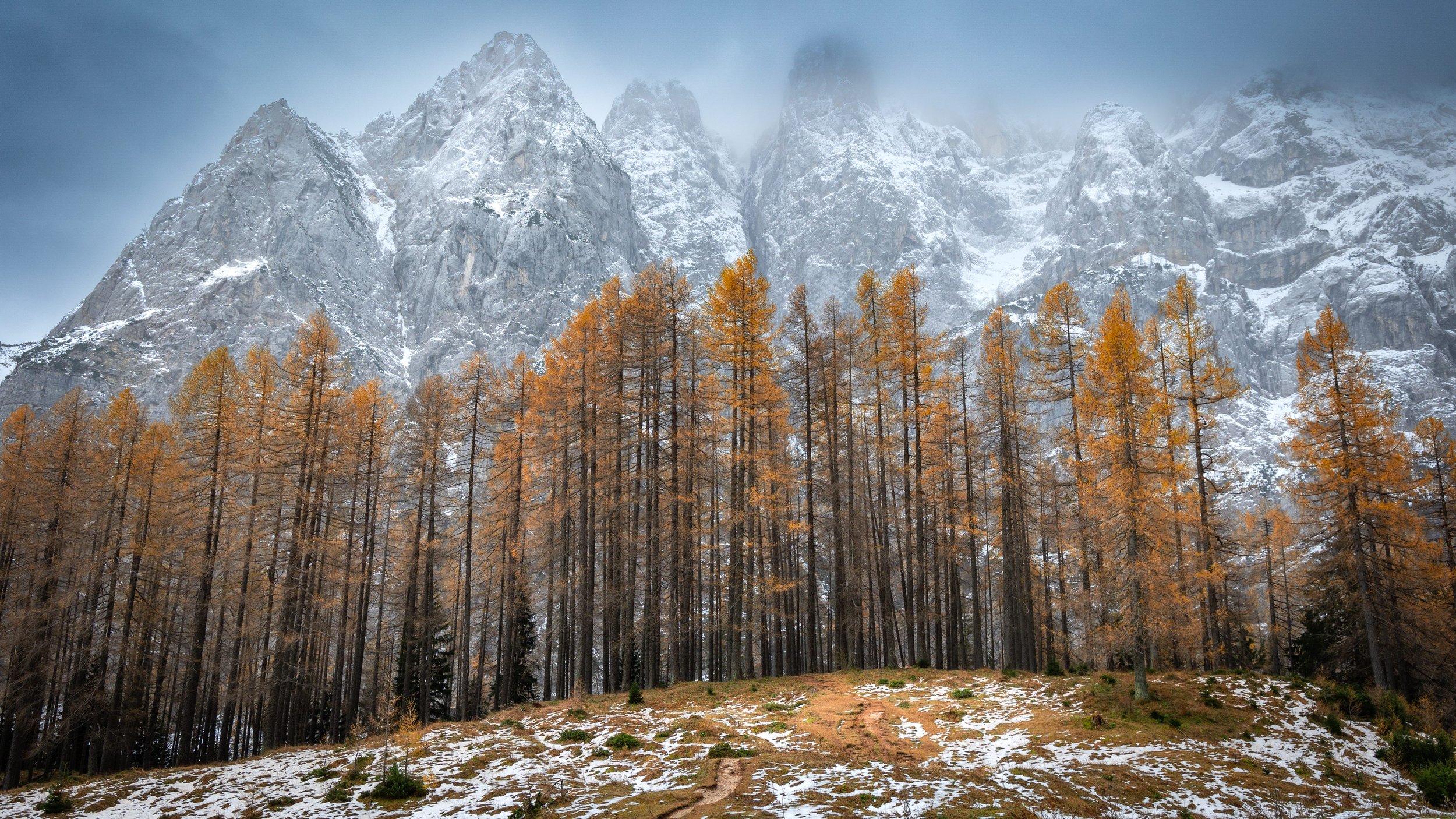
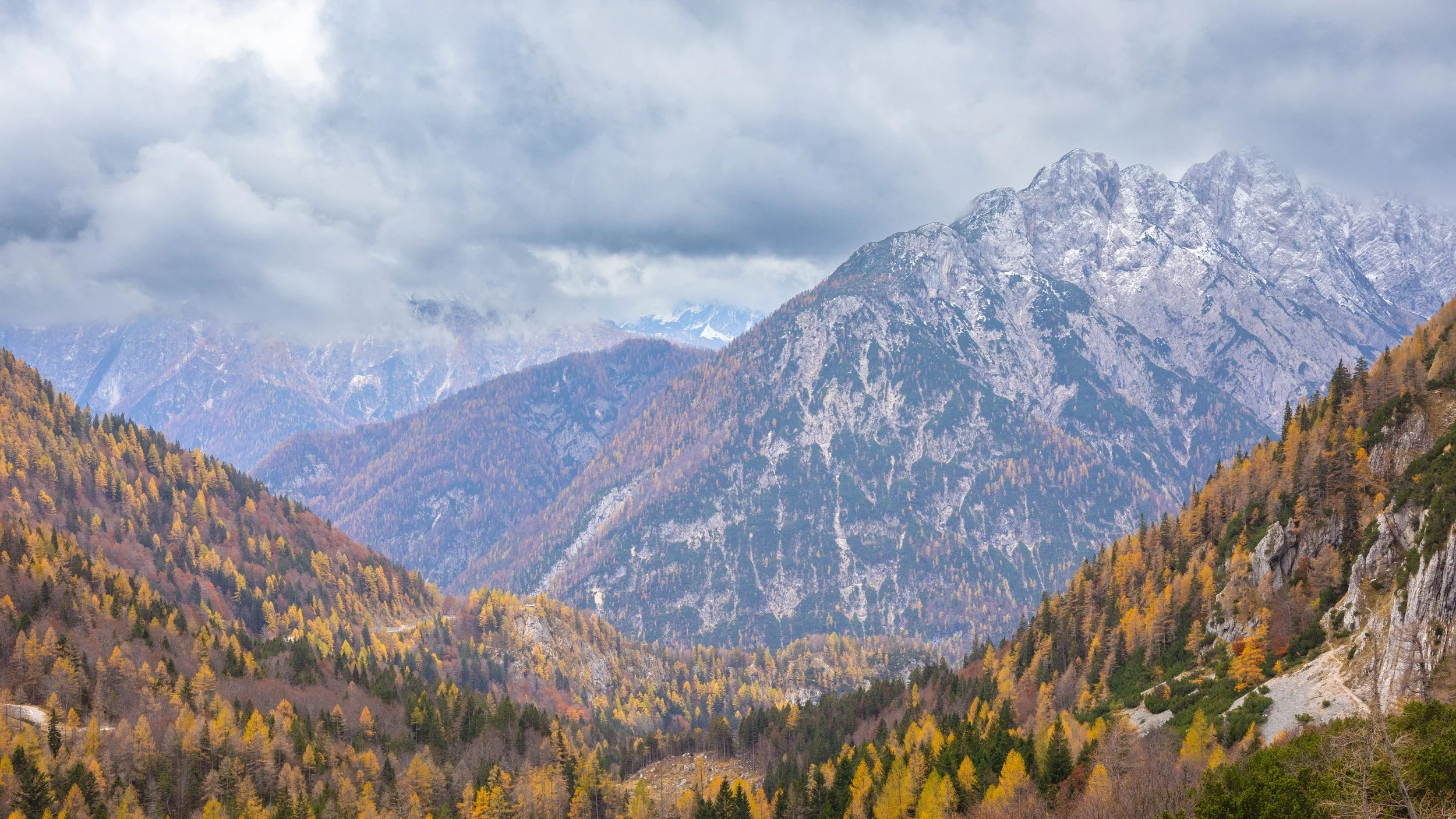
Two-thirds of the way up, I pulled into a lay-by. A line of golden larch trees and creeping pines caught my eye, their colours too striking to ignore. I grabbed my Canon, took a few handheld shots, and felt the bitter wind bite harder. Urgency set in: I needed to reach the top and descend before darkness and worsening weather closed in.
At the Summit
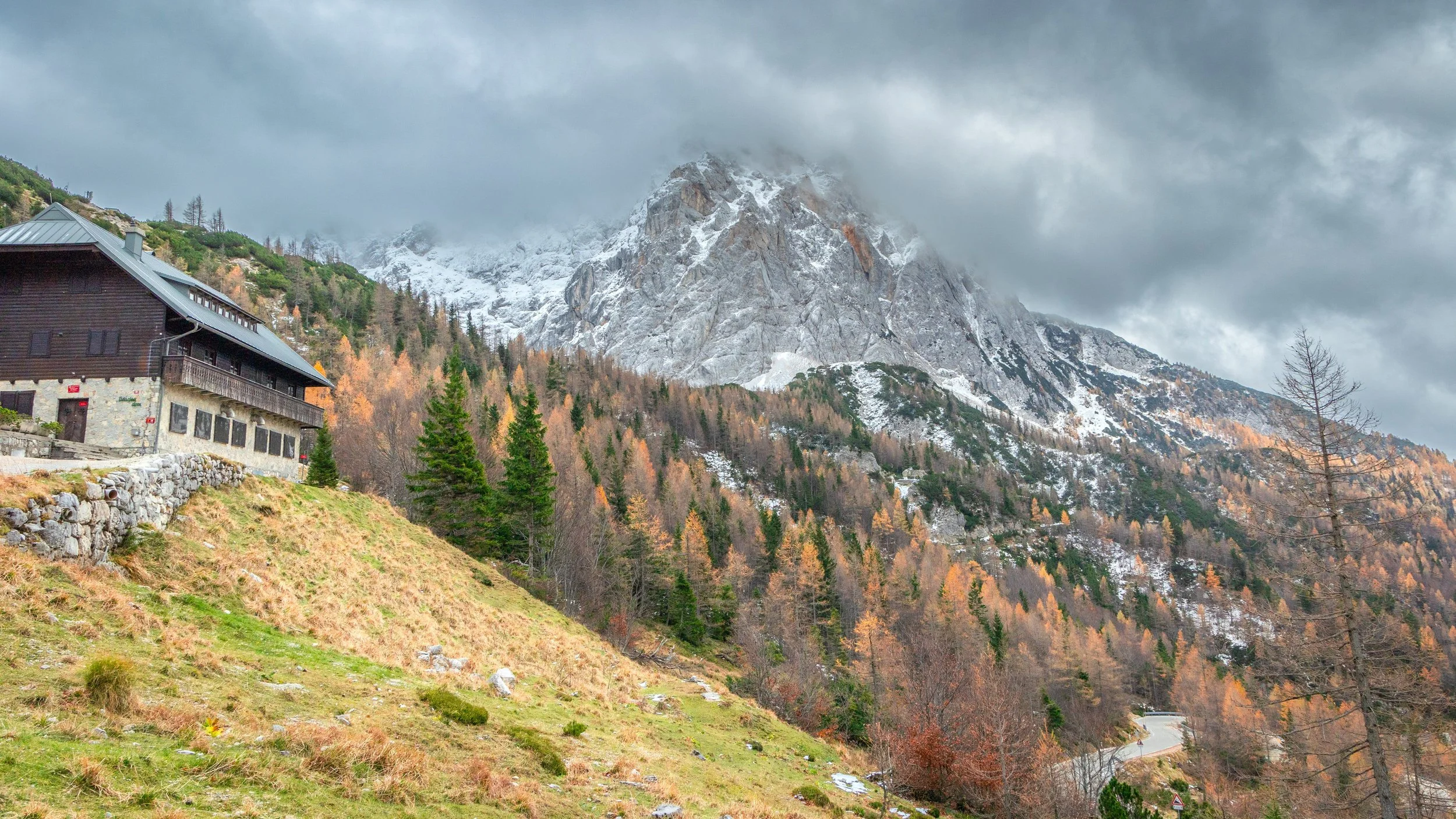
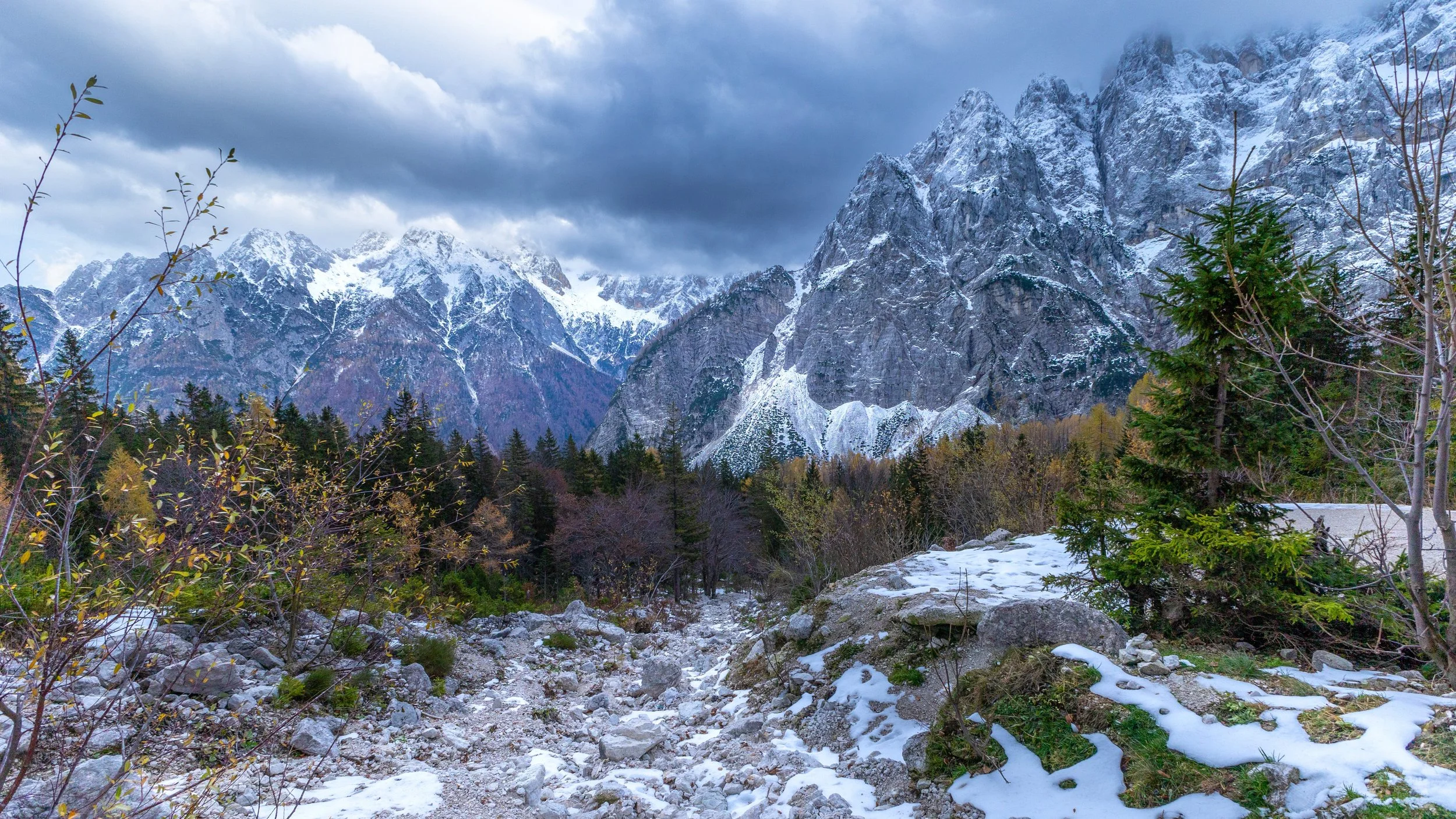
Soon after, I arrived at the pass itself. Deserted. A hut and a few lodges stood silent, the car park boundaries blurred under snow. I threw on a coat, slung my bag over my shoulder, and walked towards the centre of the pass. Within minutes, my hands were frozen, the wind cutting through my layers. Conditions were severe, and I knew I couldn’t linger. I scanned the peaks, took a handful of shots, and retreated.
Finding Shelter and a View
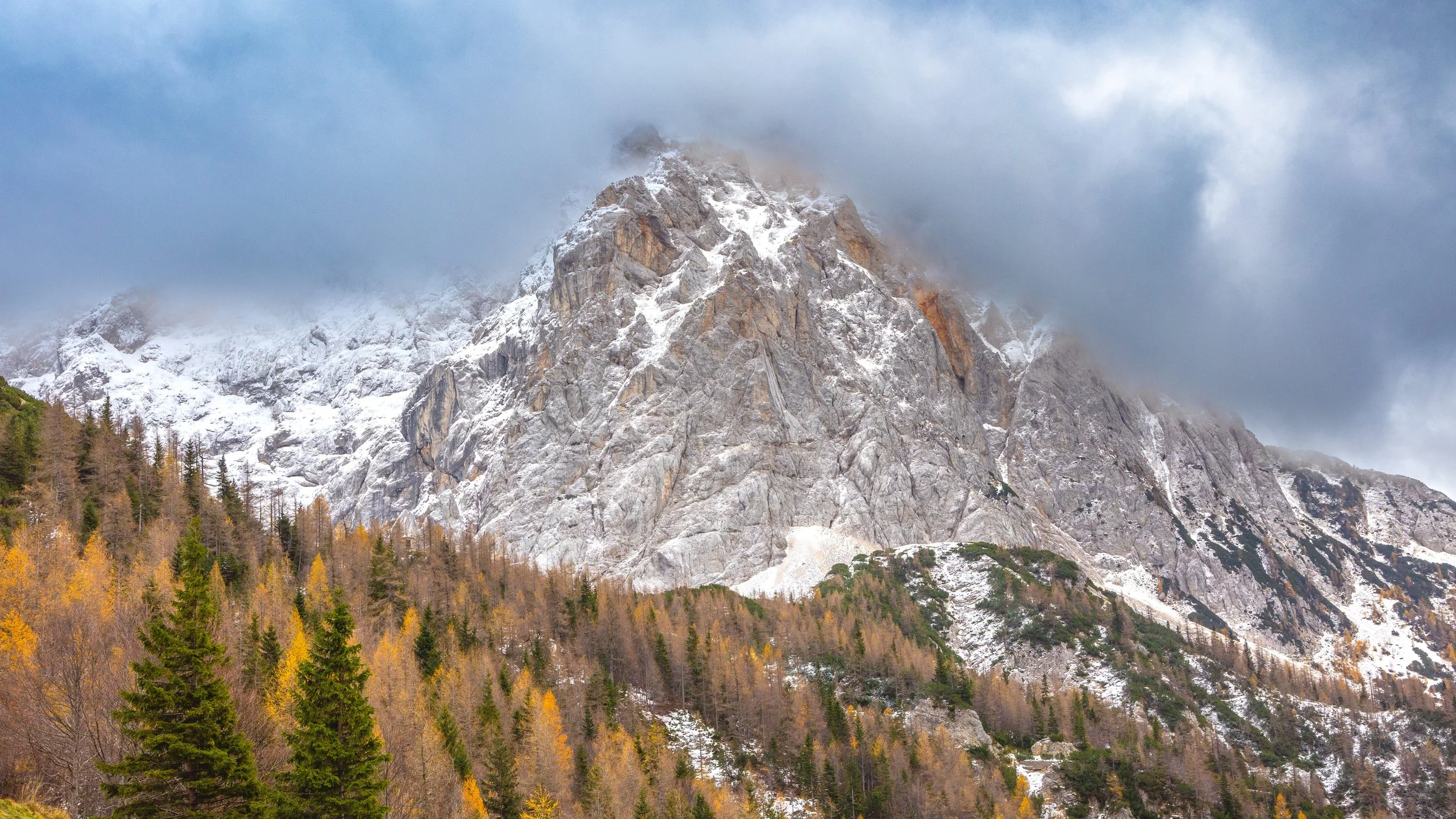
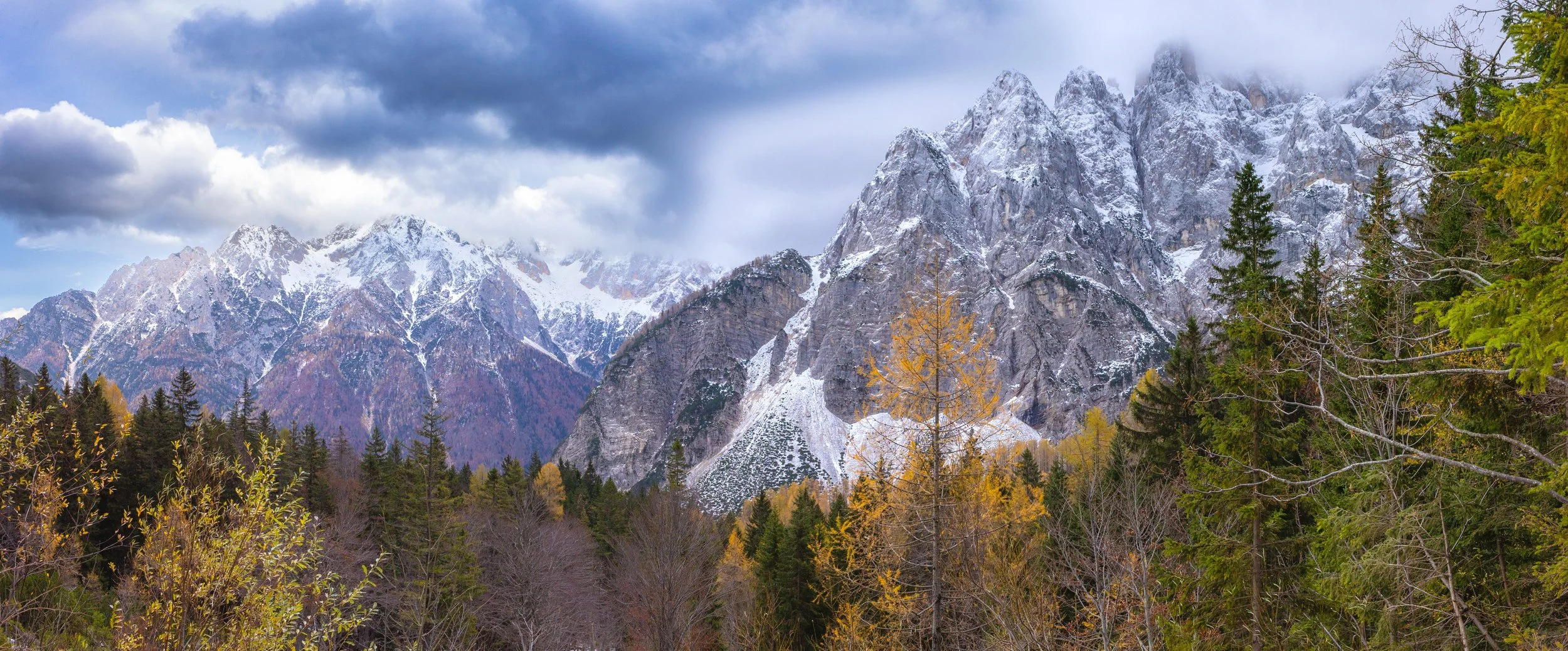
Descending, I found another lay-by sheltered from the wind. Here, the view opened across Triglav National Park, Slovenia’s crown jewel. I set up my tripod and captured several panoramic images — the kind of photographs that remind me why I endure the discomforts of mountain travel.
The shots may not be portfolio pieces, but they document the journey: the solitude, the severity, and the beauty of Slovenia’s alpine landscapes. Click to enlarge and cycle through….
Maybe watch the video?
If I have piqued your interest (excuse the pun), why not click below and watch the journey. Thanks for reading!
Epilogue: The Image Beyond the Frame
The photographs I captured at Vršič Pass are not perfect compositions. They are fragments of a larger story — of cold winds, empty roads, and the silence of a mountain holding its history. They remind me that landscape photography is not about control, but about surrender: to weather, to chance, to the fleeting moment when light and place align. I freely admit to havig been overwhelmed on more than one occasion in recent years - by the enormity and sheer beauty of the nature I have found myself in, mostly in wild and remote locations.
When I look back at these images of Vršič, I see more than scenery. I see the adventure that carried me there, the doubts I wrestled with, and the exhilaration of standing alone at the highest pass in Slovenia. That is the gift of photography: it turns experience into something you can hold, share, and revisit — a reminder that the journey itself is the true subject.
Reflections
If you’d like to follow the adventure in motion, I’ve linked to my YouTube channel where you can watch my attempts to capture Slovenia’s nature in real time.
For those curious about visiting, here are a few facts about Vršič Pass:
Elevation: 1,611 m (5,285 ft) — the highest pass in Slovenia and the Eastern Julian Alps.
Name: Vršič means “little peak,” originally referring to Mount Vršič (1,738 m / 5,702 ft), just east of the pass.
History: After World War I, the pass marked the border between Italy and Yugoslavia. Since 1945, it has been part of Slovenia.
Surroundings: Peaks around the pass rise well above 2,000 m.
Road: 50 hairpin bends (25 up, 25 down), built and improved by Russian prisoners of war in 1915. The Russian Chapel still stands near the summit.